
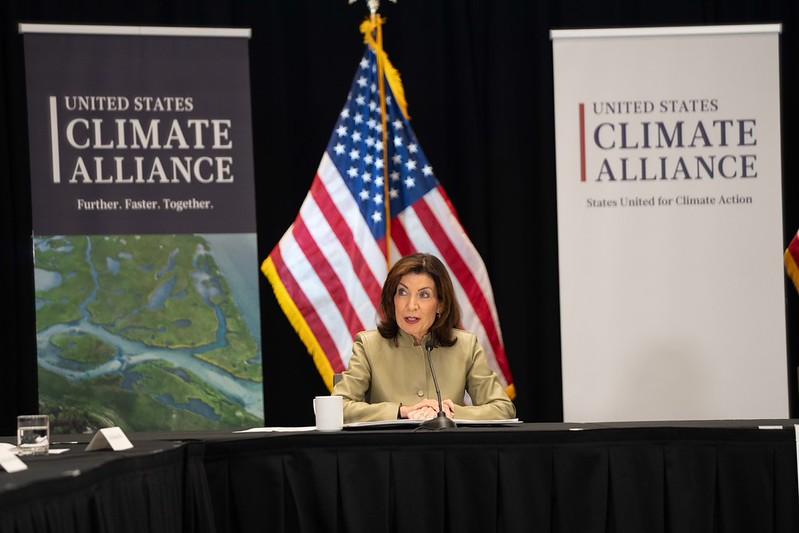
Image: Governor Hochul at NYC Climate Week in 2025 via Flickr
For years, the fossil fuel industry in New York State and nationwide and allied corporate lobbying groups fought to block the passage of the Climate Leadership and Community Protection Act (CLCPA), a groundbreaking law that committed New York to meeting a series of rolling pollution reduction mandates in order to decarbonize the state’s power generation sector. When that effort failed in 2019, the industry pivoted to seeking to delay the implementation of the law and hollow out its requirements. Fossil fuel corporations secured spots for fossil fuel executives and allies on the state Climate Action Council, launched an astroturf campaign to hold up the finalization of the Council’s plan, and commandeered New Yorkers’ utility payments to fund lobbying campaigns against legislation meant to implement the CLCPA’s mandates. In the few months immediately after Kathy Hochul took office in August 2021, fossil fuel lobbyists flooded her campaign account with donations, setting a fundraising record just before she faced an election for the seat she inherited after Andew Cuomo resigned in disgrace.
Now, Governor Hochul is pulling out all the stops to answer the fossil fuel industry’s prayers, refusing to implement the climate law and holding the state budget hostage for more than a month seeking to undo it. What’s more, Hochul is embracing other policies to increase New York’s fossil fuel consumption, including permitting a fracked gas pipeline that had previously been rejected by state environmental regulators and seeking to build out energy intensive data centers amid a flood of money from the AI industry.
Hochul, who once referred to climate change as “an existential threat” and who once declared that “there are no kings in America”, is now attempting to unilaterally usurp the democratic process in New York State in order to lock the state into a prolonged dependence on fossil fuels and to enable polluters to continue pumping dangerous waste into the air. Today Hochul’s rhetoric on climate change is nearly indistinguishable from that of the fossil fuel industry. Though she still acknowledges human-driven climate change, she consistently frames the issue as a binary choice between affordability and protecting New York’s environment.
Governor Hochul’s demand that the legislature allow her to kick the can until the end of the upcoming gubernatorial term may spare her the difficult task of taking on leadership in a difficult moment, but will effectively dump the higher costs and mounting damage from unabated climate change onto future generations of New Yorkers.
Hochul withholds critical pollution regulations
Climate change is a major concern for New York voters, and when she first took office Governor Hochul signaled that she would take the issue seriously.
Hochul began 2023 by announcing that New York would meet its mandates under the Climate Leadership and Community Protection Act by implementing a “cap-and-invest” system which would set legal limits (the “cap” component of cap-and-invest) on the amount of air pollution that could be created in the state and require polluters to pay for permission to pollute up to that cap. The state would then use the money generated by selling pollution permissions to invest in the transition off of fossil fuels, including cash refunds to New Yorkers to offset the costs of that transition (the “invest” component of cap-and-invest). The energy industry think tank Resources for the Future estimated that, if implemented, New York’s cap-and-invest program would have returned between $910 million and $1.53 billion to New Yorkers in 2026.
That same year, Hochul signed into law the All-Electric Building Act, which would require that newly built homes use electricity for heating and cooking beginning in 2026.
But by 2024, the middle of her first elected term, Hochul’s position had shifted.
Hochul’s Department of Environmental Conservation failed to release the regulations it had developed to give effect to the cap-and-invest program by January 1, 2024 as was required by the climate law. By 2025, Hochul had announced that she intended to indefinitely delay even releasing the draft cap-and-invest regulations in order to “get it right”, ignoring both the fact that the regulations had gone through an extensive design process, including three years of deliberation within the Climate Action Council and extensive public engagement by the DEC and the New York State Energy Research and Development Agency, and the fact that in a democracy, the governor does not have the option to pick and choose which laws they obey.
As New York Focus reported, though Hochul’s DEC claimed they were withholding the regulations in order to gather more feedback, there was no indication that the agency was conducting any additional engagement with stakeholders around the issue.
Environmental justice organizations across the state sued Hochul in March of 2025 over her refusal to follow the CLCPA. Hochul lost that suit in October 2025, and rather than complying with the order that she follow the law and release the cap-and-invest regulations, Hochul committed more public resources to appealing the verdict.
Now in 2026 – nearly seven years after the CLCPA was signed into law and more than two years since cap-and-invest regulations were drafted – Hochul has sought to use the state’s budget process to force the legislature to gut the CLCPA, attaching her plan to delay and drastically weaken the law to bills to fund New York’s government for the year. Hochul’s proposal would delay the release of cap-and-invest regulations until 2030, the last year of the upcoming gubernatorial term and, perhaps more critically, change how the state accounts for methane pollution to make it appear as if the state is cutting its pollution faster than it actually is by adopting a methodology that has been discredited for years.
Pollution, pipelines, data centers
But Governor Hochul hasn’t only undermined New York’s climate responses by illegally delaying the cap-and-invest program. Since the first year of her first full term, Hochul has delayed the implementation of other policies meant to reduce pollution and help achieve the mandates of the CLCPA, reversed the Department of Environmental Conservation’s previous rejection of a fracked gas pipeline through New York Harbor, and embraced the build out of energy-intensive data centers across the state.
In June 2024, as Hochul missed the legal deadline for publishing cap-and-invest regulations, the Governor made an eleventh hour decision to delay the start of Manhattan’s long-awaited congestion pricing plan. Despite having all of the infrastructure being in place, Hochul was cowed by the invective of President Donald Trump, who inveighed against congestion pricing on social media and cable television. The plan did eventually go into effect seven months later, albeit in a watered-down form with lower tolls for personal vehicles and app-based taxi services.
At almost the same time as she was fighting environmental justice groups’ lawsuit over cap-and-invest, Hochul also declared that she was also pre-emptively suspending implementation of the All-Electric Building Act pending the outcome of another lawsuit, this one brought by fossil fuel utility corporations. The Act, which would require some newly-built homes to install electric appliances for heating and cooking rather than fossil-fueled ones, was meant to go into effect at the beginning of 2026.
Further, Hochul has ignored other environmental regulations on the books, allowing corporate interests to dump massive amounts of pollution into the atmosphere. In 2024 the Buffalo News reported that most of the biggest polluters in Western New York had been operating for years without permits from the Department of Environmental Conservation, resulting in “skyrocketing greenhouse gas emissions”, including from a cryptocurrency mining facility and fracked gas transmission infrastructure.
Beyond postponing and neglecting environmental laws and regulations, Hochul has also supported the build-out of additional infrastructure that will effectively lock New York into escalating consumption of and dependence on fossil fuels.
In late 2025, Hochul overturned a decision by New York’s environmental regulator and resurrected Williams Companies’ Northeast Supply Enhancement Pipeline, after facing criticism from Donald Trump on social media and on cable news. The Department of Environmental Conservation rejected this pipeline in 2020, declining to award the project certification under the state’s Clean Water Act after a full public process due to its impacts on the environment . Williams Companies, the pipeline owner, is also a client of Davis Polk, the elite law firm that hired Hochul’s husband in January 2024, as the New York Times has reported.
Moreover, Hochul has fully embraced the rapid proliferation of energy hungry data centers to serve the ballooning demands of the so-called “artificial intelligence” industry, despite the impact of constantly-running intensive computing on the state’s power grid. Hochul has announced a public-private initiative, dubbed the Empire AI Consortium, to spend tens of millions of dollars of public money building supercomputers at State University of New York campuses. She also lauded Tesla CEO Elon Musk for his short-lived plan to build an AI supercomputer at the corporation’s publicly-owned factory in Buffalo, which was originally meant to build solar panels.
In October 2025, a lobbyist for AI companies held a fundraiser for Hochul with figures from that industry, the New York Times has reported. We found that in her January 2026 campaign finance filing, Hochul reported raising at least $270,000 from donors with ties to Anthropic, OpenAI, and other corporations and groups in the sector.
Hochul has also remained publicly neutral about an unpopular data center planned for a rural industrial park in Western New York adjacent to protected lands and the territory of the indigenous Tonawanda Seneca Nation, though as Investigative Post has reported, Hochul used her power to rush the construction of the industrial park where the data center was planned, resulting in pollution and environmental law violations and has been a vocal supporter of data center growth.
As backlash against the spread of data centers has grown, Hochul announced that, in order to prevent these facilities from raising New Yorker’s electricity bills, she intended to require data centers to “supply their own energy” – which would surely entail the installation of huge amounts of gas-burning turbines that emit tons of carbon pollution, as is the case with Elon Musk’s notorious facility in Memphis, Tennessee.
The years-long fossil fuel campaign to pollute New York
As we reported in late 2025, the backdrop for Hochul’s about-face on climate change was a multi-million dollar lobbying campaign by some of the most powerful fossil fuel and petrochemical interests, deployed not just in New York State, but in the entire world. A group of 17 major polluting corporations and political pressure groups representing those corporations had spent almost $16 million since 2021 on an escalating lobbying effort targeting cap-and-invest.
In fact, the lobbying campaign to derail the implementation of the cap-and-invest regulations is only the latest push in the industry’s more-than-a-decade-long effort to block, delay, and water down climate action and environmental regulation in New York.
LittleSis has been reporting on this pressure campaign since our 2016 report, “The Carbon Council of New York State”, which examined the fossil fuel interests behind the corporate lobbying organization and statewide chamber of commerce the Business Council of New York State and the efforts by the Business Council and its constituent members to block the Climate and Community Protection Act, the bill which would eventually become the CLCPA when it passed four years later.
After the CLCPA was signed into law in 2019, the same corporate interests that blocked the climate law for years switched gears to thwarting its implementation, setting their sights on the state Climate Action Council, which was convened pursuant to the CLCPA to devise a plan to meet its requirements. As we reported inApril 2022 and in our later report “Fueling Obstruction”, fossil fuel corporations and their allies secured key appointments on the council – including National Fuel Gas executive Donna DeCarolis, power plant lobbyist Gavin Donohue, and longtime National Grid executive Dennis Elsenbeck – who sought to water down the content of the state’s climate plan and to delay its release. The industry also launched an astroturf group, named New Yorkers for Affordable Energy, to mislead the public about the climate law and induce people to oppose it.
Now, under Governor Hochul’s watch, all of the fossil fuel industry’s myriad efforts and millions of dollars spent on lobbying, campaign donations, and lawsuits appear to have paid off as Hochul hijacked the must-pass budget bills that fund New York’s government in order to coerce lawmakers into eviscerating the law. Rather than taking on the powerful interests polluting into New York’s air, land, and water and following through on lawmakers’ commitment to a clean and healthy environment for all New Yorkers, Hochul has chosen instead to establish her legacy as one of capitulation to corporate donations and protecting fossil fuel profits over the welfare of future generations.